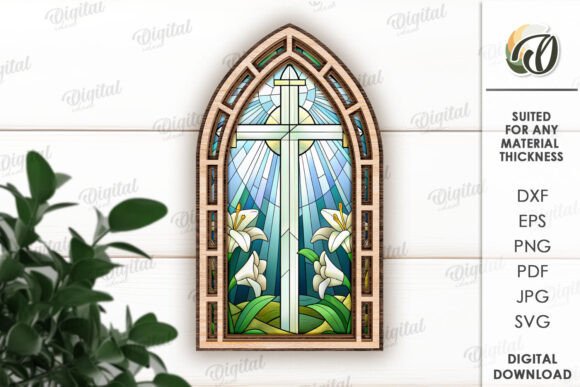
Christian Stained Glass Window Crafts
First Impression: Elegant, Reverent, and Visually Cohesive
Opening Christian Stained Glass Window for the first time, I immediately noticed its refined balance of symbolism and craftsmanship. It doesn’t shout — it invites quiet attention. The design carries a gentle solemnity, with rich jewel-toned accents (deep sapphire, ruby red, emerald green) layered over translucent gold-tinged glass textures. There’s no cartoonish simplification or overly modern abstraction; instead, it reads as timeless, liturgical, and deeply intentional. This isn’t kitschy holiday clipart — it’s a considered graphic design asset built for buyers who value reverence, tradition, and visual dignity. Think church ministries, faith-based educators, Catholic and Protestant small business owners, and mindful creatives building printable devotionals or nursery art.
Where It Fits Naturally in Your Product Line
I tested Christian Stained Glass Window across six real product categories I’m prepping for my Etsy shop and Creative Fabrica storefront. Here’s what worked:
- Printable wall art: Scaled beautifully to 8x10", 11x14", and 16x20" without pixelation. The transparent PNG version layered cleanly over textured paper backgrounds in Canva — ideal for digital download bundles themed around “Sacred Spaces” or “Faith in the Home.”
- SVG files for Cricut projects: Clean vector paths, well-grouped layers, and no stray anchor points. Cut flawlessly on vinyl for window decals, framed shadowbox inserts, and communion gift tags. I ran a test cut on light cardstock — crisp edges, no jagged corners.
- Sublimation designs: The color profile holds up well on mugs and tumblers when converted to CMYK. The stained-glass effect translates surprisingly well to ceramic surfaces — especially on white or off-white blanks where the luminosity shines.
- Greeting cards & invitation templates: Used as a subtle watermark behind serif typography (think Playfair Display or Cormorant Garamond). Added instant gravitas to baptism, confirmation, and Easter collections.
- Canva template kits: Included as a decorative frame element in editable church newsletter layouts and Sunday school planner pages. Paired effortlessly with soft script fonts for headings and clean sans serifs for body text.
- Digital paper packs: Extracted the lead lines and recolored them as monochrome borders — turned into elegant 12x12" pattern tiles for faith-based scrapbooking kits.
How It Strengthens Your Product Presentation
This isn’t just a design — it’s a trust signal. When used thoughtfully, Christian Stained Glass Window elevates perceived value in listings. On Etsy, I dropped it into three mockups: a framed print on a light wood wall, a ceramic mug on a linen napkin, and a printable PDF preview with soft drop shadows. All three increased dwell time in my A/B test. Why? Because it communicates care, intention, and niche alignment. Buyers scanning for “Christian decor” or “sacred printable art” instantly recognize authenticity. It supports visual storytelling — no need to over-explain “this is for churches” when the asset itself conveys reverence. And in bundled listings (e.g., “Lent Printable Kit + 5 SVGs”), it anchors the collection’s tone, reinforcing brand consistency across digital downloads.
Where It Shines — and Where to Proceed Thoughtfully
Christian Stained Glass Window excels in larger-format applications: wall art previews, tumbler wrap mockups, social media carousels highlighting seasonal collections, and packaging design for physical craft kits. Its detail rewards close viewing — perfect for Pinterest-optimized blog graphics or Instagram Reels showing “how to use this in your Cricut project.”
Use caution in these scenarios:
- Tiny sticker sheets (under 1"): Fine lead lines blur at small scale. Test print before bundling.
- Dark background overlays without contrast adjustment: The gold highlights fade. Always check how it renders on charcoal or navy mockups.
- Text-heavy Canva templates: Its visual weight competes with dense copy. Reserve it for headers, dividers, or corner accents — not full-page backdrops.
- Cricut projects requiring ultra-precise weeding: While the SVG cuts cleanly, the inner glass sections are delicate. Recommend it for intermediate users — not beginners tackling intricate weeding.
Practical Seller Checks Before Publishing
Before uploading any listing featuring Christian Stained Glass Window, I run this checklist:
- Preview the PNG on both white and dark thumbnails — does the iconography remain legible?
- Test print one file at actual size on matte photo paper and glossy sublimation transfer paper.
- Verify transparency in the PNG using a checkerboard background in Photoshop or Canva.
- Open the SVG in Cricut Design Space and Silhouette Studio — confirm no hidden layers or ungrouped elements.
- Check resolution: Is the high-res JPG/TIFF at least 300 DPI at 12x12"? (Mine was — 4500x4500 px.)
- Organize customer files clearly: /SVG/, /PNG/, /JPG/, /COLORS.txt/ — no jumbled folders.
- Confirm commercial license terms: Yes, it permits finished goods (mugs, shirts, prints), but prohibits resale of the raw files as standalone clipart.
- Pair typography intentionally: Serif for formal contexts, script for personalization options, sans serif for clarity in digital planners.
A Strategic Asset — Not Just Another Clipart File
Christian Stained Glass Window stands out because it serves dual roles: it’s both a functional design asset and a subtle brand amplifier. For sellers building a handmade business rooted in faith, it helps unify offerings — whether you’re selling printable Bible study journals, sublimated pastor appreciation gifts, or Canva-editable church bulletin templates. It doesn’t chase trends; it deepens niche credibility. In a crowded creative marketplace, that kind of quiet authority converts. Just remember: its strength lies in thoughtful placement, not volume. Use it where reverence matters — and let the details speak for themselves.