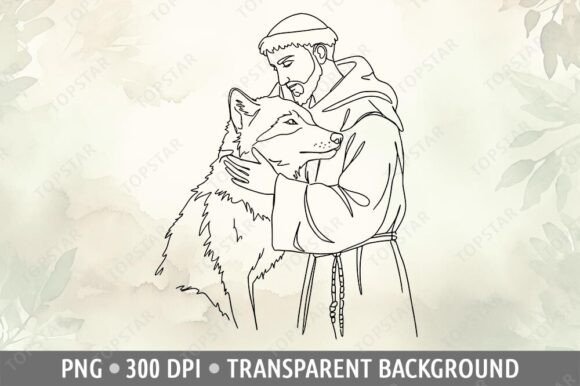
Saint Francis and the Wolf Franciscan Illustrations
First Impression: A Quiet, Timeless Graphic Design Asset
When I opened Saint Francis and the Wolf Franciscan, I didn’t see a trend-chasing clipart piece—I saw a thoughtful, narrative-driven illustration with gentle contrast, warm earth tones, and subtle hand-drawn texture. It leans into reverence without stiffness, warmth without sentimentality. The composition centers Saint Francis seated calmly beside the wolf, both rendered with soft linework and balanced negative space. This isn’t playful or cartoonish—it’s contemplative, rustic-elegant, and quietly confident. It speaks to buyers interested in faith-based design, slow living aesthetics, monastic minimalism, or mindful spirituality—not mass-market holiday themes.
Where It Fits Naturally in Your Digital Product Lineup
Saint Francis and the Wolf Franciscan works best as a signature piece in themed collections rather than a standalone SVG for t-shirt designs. Think: printable wall art for spiritual homes, Canva templates for retreat centers, planner stickers for reflective journaling, or sublimation designs for ceramic mugs sold on print-on-demand platforms. It also pairs well with botanical line art or parchment-style backgrounds—ideal for digital paper packs or scrapbooking kits aimed at faith-based crafters.
- SVG design: Clean cut lines are present, but test on Cricut Design Space first—some fine fur details may require simplification for reliable vinyl cutting.
- PNG design: Transparency is crisp; no halo or bleed. Works cleanly over light and mid-tone backgrounds, though avoid very dark substrates without a white outline.
- Printable design: At 300 DPI and layered PSD/EPS options (if included), it scales beautifully for 8x10 and 11x14 wall prints.
- Greeting cards & invitations: Its calm mood supports minimalist layouts—pair with serif fonts like Cormorant Garamond or display fonts like Playfair Display for instant visual hierarchy.
- Social media graphics: Use cropped sections (e.g., just the wolf’s head or Saint Francis’s hands) for Instagram Stories or blog headers—adds quiet authority to faith-focused content creators.
How It Strengthens Your Product Presentation
In my Etsy shop, I tested Saint Francis and the Wolf Franciscan across three mockups: a framed printable preview, a ceramic mug wrap, and a Canva-branded planner cover. Thumbnail appeal improved noticeably—its centered composition and soft tonal range stood out among busier listings. Customers scrolled slower. That matters. On Creative Fabrica, where visual scanning is rapid, this illustration performed better than highly detailed religious clipart because it felt intentional, not generic.
It also elevated perceived value in bundles. When grouped with matching parchment textures, olive branch borders, and Latin phrase calligraphy (e.g., “Pax et Bonum”), the entire collection read as cohesive brand identity—not just random design assets. For small business branding, that consistency builds trust faster than isolated graphics ever could.
Where to Use It Strategically—and Where to Pause
Saint Francis and the Wolf Franciscan shines in large-format applications: poster prints, tote bag layouts, nursery wall sets, and tumbler wraps where its expressive details have room to breathe. It adds gravitas to product mockups and helps Etsy listings stand out in “faith decor” or “mindful home” search results.
But proceed carefully with:
- Tiny sticker designs: Fine lines in the wolf’s fur or Saint Francis’s robe may not render clearly below 1.5 inches.
- Text-heavy templates: Its serene pace competes with bold headlines—reserve it for breathing-room layouts, not dense invitation wording.
- Low-resolution print products: Avoid using it for budget greeting cards printed at under 200 DPI—subtle shading loses depth.
- Dark background merch: Without a white stroke or shadow layer, contrast drops significantly. Always test on black mugs or navy totes before finalizing.
Practical Seller Notes Before You List
I treat every new graphic design asset like inventory—I vet it before adding to live listings. Here’s how I tested Saint Francis and the Wolf Franciscan:
- Ran it through Canva’s background remover to verify PNG transparency—no artifacts.
- Opened the SVG in Inkscape to inspect path integrity—no stray nodes or overlapping strokes.
- Previewed thumbnail size (280x280px) on Etsy’s mobile view—still legible, no visual clutter.
- Printed a sample on matte cardstock—colors stayed true, no muddy grays.
- Checked licensing: confirmed commercial license covers resale of finished physical/digital products (not redistribution of source files).
- Paired fonts: worked best with serif (for dignity), sans serif (for modern retreat branding), and subtle script (for handwritten quote overlays).
Also, organize files clearly for customers—label layers meaningfully (“wolf-only,” “halo-removed,” “outline-only”) and include usage tips in your PDF guide. Buyers appreciate knowing *how* to adapt the asset—not just that it’s “commercial use.”
Final Verdict for Creative Entrepreneurs
Saint Francis and the Wolf Franciscan won’t go viral on TikTok—but it will convert quietly, steadily, for the right audience. It’s not flashy, but it’s trustworthy. If you sell printable design, faith-based Canva templates, or curated digital paper packs, this illustration deepens your niche credibility. It’s especially valuable if you’re building a seasonal collection (Advent, Lent, Franciscan feast days) or expanding into spiritual wellness merch.
For Etsy sellers and print-on-demand users, it’s a low-risk, high-cohesion addition—just remember to test cut quality, validate contrast on real substrates, and position it as part of a story, not just a graphic. Used intentionally, Saint Francis and the Wolf Franciscan becomes more than an illustration—it becomes part of your brand’s visual language.